
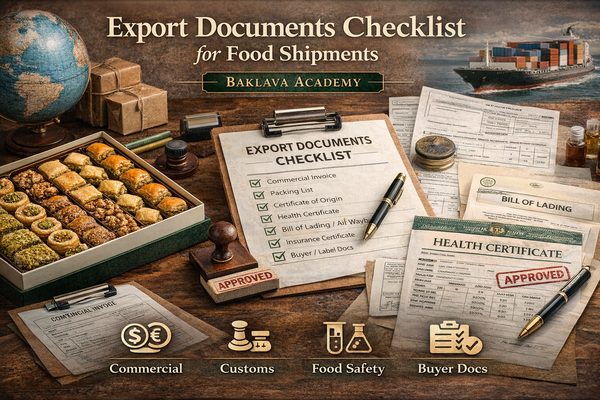
The export document stack (what you need, and when)
Think in four layers: Commercial (payment & sale), Customs (clearance), Food/Quality (safety & traceability), and Buyer/Brand (retail approval). Not every destination needs every document, but missing one “required” item can stop clearance.
Key takeaways
- Invoice + packing list must match: HS codes, net/gross weights, carton counts, prices, Incoterms.
- Traceability is non-negotiable: lot codes + production date mapping (and shelf-life where requested).
- Food files reduce buyer delays: ingredient spec, allergens, COA, and label artwork are often requested before shipping.
- Transport docs drive customs: AWB/B/L details must match consignee/importer and packing list totals.
On this page
1) Commercial documents
- Commercial Invoice (core): seller/buyer details, Incoterms, currency, HS code(s), item description, unit price, total value.
- Packing List (core): carton/pallet details, net/gross weights, dimensions, SKU/lot codes, carton counts.
- Sales Contract / Proforma Invoice (common): used for payment terms, product specs, and pre-approval.
- Insurance Certificate (when applicable): especially for CIF/CIP or buyer-requested coverage.
2) Customs & transport documents
- Export Customs Declaration (core): filed by exporter/broker per origin country procedures.
- Certificate of Origin (COO) (often): sometimes chamber-stamped; needed for preferences or buyer policy.
- Transport Document (core): Air Waybill (AWB) for air or Bill of Lading (B/L) for sea.
- Freight Invoice / Booking Confirmation (useful): helps confirm route, ETD/ETA, and handling notes.
- ISPM-15 Wood Packaging (when pallets are wood): pallet treatment marking and compliance.
Tip: “consignee vs importer of record”
Many delays come from using the wrong party name on the AWB/B/L. Confirm who is the importer of record and ensure the paperwork matches the broker’s instructions.
3) Food safety & quality documents
These are the documents that keep food shipments from being held “for review” by the buyer or border authorities.
- Ingredient Statement + Allergen Declaration (common): nuts, dairy, gluten; “may contain” statements as needed.
- Certificate of Analysis (COA) (common): batch-based or periodic; include microbiology/quality parameters relevant to your product.
- Lot / Batch Traceability Sheet (strongly recommended): lot codes, production date, best-before, and carton mapping.
- Food Safety System Evidence (buyer-driven): HACCP/ISO 22000/BRC/IFS certificates if available.
- Health / Sanitary Certificate (destination-dependent): sometimes required; often requested by importers even when not mandatory.
4) Buyer / retail approval documents
- Final Label Artwork (print-ready) + translations (if required): ingredients, allergens, net weight, storage, importer info.
- Nutritional Information (destination-dependent): panel format varies by market.
- Halal Certificate / Declaration (when requested): scope should match the SKU and facility.
- Product Specification Sheet: dimensions, piece count, syrup level, shelf life, storage conditions.
- Photos / Case markings: carton labels, pallet labels, barcode/GTIN where applicable.
The “match test” (prevent delays)
Before dispatch, check these match across invoice, packing list, and AWB/B/L:
- Consignee name + address (exact spelling)
- HS code(s) and product description
- Total cartons, pallets, net weight, gross weight
- Lot codes / production dates (if listed)
- Incoterms + freight terms
- Declared value and currency
Common delay patterns
- Invoice says 1,200 kg net but packing list totals 1,180 kg.
- AWB shows 10 cartons; packing list shows 12 cartons.
- Importer requests label with their address, but shipment ships with old artwork.
Copy-paste templates
Template: “documents ready” email (to buyer/broker)
Attached are the shipment documents for [PO/Invoice #____]: Commercial Invoice, Packing List, Certificate of Origin (if applicable), COA, Allergen/Ingredient Declaration, and [AWB/B/L] draft for confirmation. Please verify consignee/importer details, HS code(s), and totals (cartons, net/gross weight) and confirm approval to release the final transport document.
Template: traceability table header
- SKU / Product name
- Lot code
- Production date
- Best before
- Carton count
- Net weight per carton
- Carton range (e.g., 1–120)
Related: Allergens & Labeling • Halal Considerations • Logistics & Export
FAQ
What are the “must-have” documents for nearly every shipment?
Commercial Invoice, Packing List, and AWB/B/L are the core trio. Many shipments also require an export declaration and (often) a certificate of origin depending on the destination and buyer policy.
Which documents should be finalized before production?
Label artwork (including importer address if required), ingredient/allergen declaration, and product spec sheet. Buyers often approve these before placing repeat orders or private label runs.
How do I reduce clearance risk on first shipments?
Ask the importer/broker for their “first shipment checklist” and match it exactly, then run the match test across invoice, packing list, and AWB/B/L draft before dispatch.