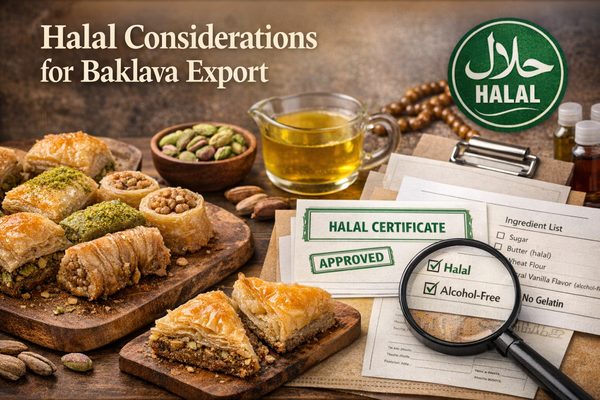
Halal export: what buyers really check
In most baklava, the big concern is not “meat”—it’s hidden sources and carrier systems: flavorings, emulsifiers, processing aids, and cross-contact in shared facilities.
Key takeaways
- Confirm sensitive inputs: flavorings (alcohol carriers), emulsifiers (mono-/diglycerides), enzymes, and any glazing agents.
- Clarify butter/ghee sourcing: typically halal-friendly, but buyers may want documentation and facility assurance.
- Facility controls matter: segregation and cleaning plans if non-halal items exist on-site (or in a shared complex).
- Match certification to destination: some markets accept declarations; others require a recognized halal certificate.
- Make labels “halal-safe”: avoid ambiguous ingredient wording; keep documentation consistent with the label.
On this page
1) Ingredient risks (what to watch)
Baklava’s “core” ingredients (nuts, flour, sugar, butter, water) are usually straightforward. Export issues typically come from minor ingredients and suppliers of suppliers.
- Flavorings / aromas: ask whether any flavors use alcohol as a carrier. Some buyers require “alcohol-free flavorings”.
- Emulsifiers (E-numbers / additives): if used, confirm source (plant vs animal) and halal status from the additive supplier.
- Gelatin: not common in classic baklava, but can appear in adjacent products (glazes, desserts, assortment lines). Ensure no pork-derived gelatin is present on-site if buyers are strict.
- Processing aids / enzymes: confirm if any are used in dough or syrups; request supplier halal declarations.
- Release agents / pan greases: verify composition (typically vegetable-based, but document it).
Quick rule
If an ingredient has an unclear origin (or can be animal-derived), treat it as “sensitive” and require supplier proof.
2) Facility and cross-contact controls
Even if your product recipe is halal, buyers may ask about the facility:
- Is any pork-derived ingredient handled anywhere on-site? (If yes, expect extra scrutiny.)
- Are there non-halal products made in the same rooms or on the same equipment?
- Are cleaning procedures documented and followed? (SOPs + records help.)
- Are ingredients stored segregated? (especially if multiple brands/SKUs are produced.)
Many halal-focused importers accept “halal product” only when the facility risk is controlled and documented.
3) Halal certification: when it’s needed
Requirements vary by destination and channel:
- Retailers / distributors: may accept a halal certificate, or a halal declaration + ingredient proofs (market-dependent).
- Government / institutional tenders: often require formal certification from an approved or recognized body.
- Private label: brands frequently require certification to simplify claims and avoid disputes.
If certification is required, confirm the certificate scope covers both the facility and the specific products/SKUs.
4) Documentation pack importers request
A clean halal pack reduces back-and-forth. Typical items:
- Halal certificate (if applicable) + validity dates.
- Ingredient specification (per SKU) including additives and flavors.
- Supplier halal declarations for sensitive inputs (flavors, emulsifiers, enzymes, release agents).
- Statement of no pork-derived ingredients and (if needed) no alcohol-based carriers.
- Traceability: lot/batch code mapping to production date.
- Label artwork (final) and version control.
5) Label wording that avoids confusion
Labels should be clear and conservative:
- Avoid ambiguous terms like “flavor” without clarification when your buyer is strict—specify “natural flavoring (alcohol-free)” if true and required.
- Keep the ingredient list aligned with your spec sheet—buyers cross-check them.
- If you use a halal logo or claim, ensure it matches certificate permissions (brand owners care a lot here).
Copy-paste templates
Template: halal declaration (export-ready)
We confirm that the referenced product(s) contain no pork-derived ingredients and are produced using halal-appropriate raw materials. Upon request, we provide supplier declarations for sensitive inputs (flavorings, emulsifiers, enzymes, processing aids) and batch traceability (lot codes + production dates).
Template: buyer questions checklist (send to supplier)
- Any alcohol used as a carrier in flavors? Yes/No (details): ________
- Any gelatin used anywhere on-site? Yes/No (source): ________
- Any emulsifiers/additives used? Yes/No (supplier + halal proof): ________
- Any non-halal products made on the same equipment? Yes/No (controls): ________
- Cleaning/segregation SOPs available? Yes/No
- Halal certificate available? Yes/No (scope + expiry): ________
- Batch traceability format: ________
Related: Allergens & Labeling • Private Label Baklava
FAQ
Is “halal” the same as “no alcohol anywhere”?
Not always. Some standards focus on intoxicating beverages and certain uses of alcohol. In practice, many importers (especially retail) ask for “alcohol-free flavor carriers” to keep approvals simple.
Do I need halal certification for a mixed assortment box?
If you claim halal for the assortment, each included SKU must be halal-compliant and covered by your documentation/certificate scope. Assortments are where hidden additives and cross-contact questions show up—document each variety.
What causes the most halal-related delays?
Missing proof for minor ingredients (flavors/emulsifiers), unclear certificate scope, and inconsistent documents (label vs spec sheet vs declarations).