Moisture control = crisp layers + stable syrup
The goal isn’t “dry baklava.” The goal is defined layers with controlled syrup—so the pastry stays crisp and aromatic on arrival and during shelf life.
Key takeaways
- Condensation is a top culprit: packing warm product or exposing cartons to temperature swings creates internal moisture.
- Seals matter more than claims: a high-barrier film still fails if the seal has channels, wrinkles, or oil contamination.
- Route testing beats theory: validate texture at arrival + after a 7-day hold in destination conditions.
- Moisture is a system: syrup profile, cooling, packaging, and storage conditions must match your air/sea route.
On this page
Root causes of sogginess
In export, “soft” texture typically comes from one (or a mix) of these:
- Over-absorption: pastry takes in too much syrup too quickly, blurring layers.
- Condensation: moisture forms inside packs when warm product is sealed or cartons move from cold to warm environments.
- Humidity ingress: water vapor enters through weak packaging or compromised seals.
- Moisture migration: syrup/moisture moves over time (especially with heat), softening edges first.
Production controls importers can request
You don’t need to micro-manage recipes. You need consistent, testable controls that keep texture repeatable batch to batch.
Supplier controls that matter
- Portion + weight consistency: consistent piece weight helps syrup uptake behave predictably.
- Syrup dosing method: controlled application prevents pooling and uneven absorption.
- Environmental hygiene: avoid high-humidity packing areas (especially in summer) to reduce “pre-loading” moisture.
- Batch traceability: production date, lot codes, and COA/label docs help isolate issues fast.
Cool-down & packing timing
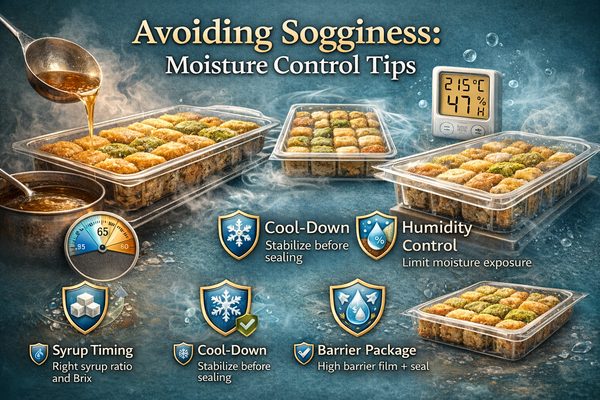
A simple rule: don’t seal heat. If the product is warm, the pack becomes a condensation chamber.
Best practices
- Cool to a stable temperature before sealing (reduces fogging and soggy edges).
- Avoid rapid temperature cycling before dispatch (e.g., cold room → warm loading bay).
- Control headspace so there’s less room for moisture to condense.
Packaging controls that block moisture ingress
For export, moisture barrier and seal integrity protect crunch more than almost any other packaging attribute.
Packaging checklist (moisture-first)
- High moisture-barrier materials appropriate for your route duration.
- Reliable seals (no wrinkles/channels; flange must be clean and dry).
- Rigid tray support so seals don’t deform under stacking.
- Grease resistance to keep oil from contaminating seals and softening layers.
If you want a companion packaging deep dive, see: Crunch Preservation: Barrier Films & Trays.
Storage + logistics tips (air vs. sea)
Air freight (shorter time, more temperature transitions)
- Watch cold-to-warm transitions (condensation risk at airports and receiving docks).
- Use sealed trays + moisture barrier to resist humid ambient air during handling.
- Plan for fast receiving and stable storage on arrival.
Sea freight (longer time, higher humidity exposure)
- Prioritize moisture barrier + seal robustness and validate with longer hold tests.
- Use strong outer cartons and humidity-aware pallet wrapping strategies.
- Test with the destination climate (especially tropical/humid markets).
Quick arrival checks for buyers
These checks help you separate recipe issues from packaging/logistics issues quickly.
Arrival checklist
- Look: defined layers, no fogging/condensation inside packs, no syrup pooling.
- Touch: top layers should feel dry/crisp, not tacky or wet.
- Smell: nut aroma should be fresh; stale notes can signal packaging oxygen ingress or heat exposure.
- Seal check: inspect corners for wrinkles or channels; check for oil/crumb contamination on seal band.
- Day-7 hold: repeat checks after 7 days at typical storage conditions.
Copy-paste moisture-control RFQ
Use this to align suppliers on measurable controls and a route-matched validation plan.
RFQ template
- Product: baklava assortment / specific SKU(s)
- Route: air / sea • destination city/country • expected transit time
- Target shelf life: ____ days (arrival + retail)
- Texture goal: crisp defined layers, no soggy edges, no syrup pooling
- Process requirement: product cooled to stable temperature before sealing
- Packaging requirement: moisture-barrier system + reliable seals; rigid tray to protect seal geometry
- Validation: arrival evaluation + 7-day hold test (destination conditions) with documented results
- Documentation: production date, lot codes, allergen statement, labeling, COA/traceability
FAQ
Is “more syrup” the same as “more soggy”?
Not always—but over-absorption and pooling are common drivers of softness. Export-ready baklava balances syrup concentration and application so the pastry stays defined while remaining flavorful.
Why does baklava arrive crisp but turn soft in a few days?
This usually indicates slow moisture ingress (small seal leaks) or moisture migration accelerated by warm storage. A 7-day hold test is the fastest way to catch this before scaling volume.
What’s the fastest “fix” for sogginess in export?
Improve the system: confirm cool-down before sealing, upgrade seal integrity (clean flange, no channels), and select packaging that blocks water vapor. Then validate on your route with arrival + hold tests.