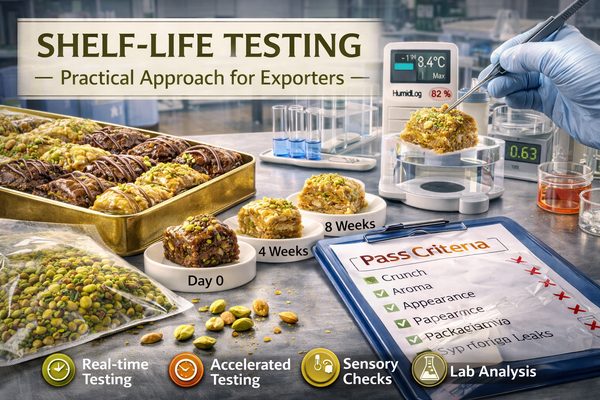
Shelf-Life Testing: Practical Approach for Exporters
Baklava Academy • Article 32 • Updated guide for importers, retailers, and hospitality brands.
Key takeaways
- Define “failure” first: crunch loss, nut oxidation, syrup/texture drift, seal leaks, odor pickup, appearance changes.
- Test the whole system: product + packaging + route. A great recipe fails in weak packaging.
- Use two tracks: real-time testing (truth) + accelerated testing (fast comparisons).
1) Start with the shelf-life question exporters actually need
The goal isn’t “how long is it safe?” It’s: how long does it stay premium after production, through transit, customs delays, warehousing, and the retailer’s shelf?
2) Map your route and pick worst-realistic scenarios
- Mode: air (fast, less heat exposure) vs sea (slow, more temperature swings).
- Holds: customs, bonded warehouse, last-mile delays.
- Climate: hot/humid markets vs cool/dry markets.
- Handling: palletization, stacking load, vibration, carton compression.
Pro tip: Put a temperature/humidity logger in pilot shipments. Your real data will outperform assumptions.
3) Choose what to measure (simple, repeatable, meaningful)
- Sensory (must-have): crunch, aroma, sweetness balance, aftertaste, visual appeal.
- Packaging integrity: seal checks, leaks, pinholes, headspace condition.
- Moisture behavior: texture drift, stickiness, softening (moisture migration is a common killer).
- Fat oxidation risk: off-notes that develop in nuts over time (especially if warm).
- Safety baseline (as required): basic micro checks aligned with your market and risk assessment.
4) Run two testing tracks
A) Real-time study (the “truth”)
- Test at: Day 0, arrival simulation (route), then periodic intervals (e.g., 2/4/6/8/12 weeks).
- Store samples under the same conditions your buyer will use (ambient vs chilled).
- Use multiple production lots (at least 3) so results aren’t a one-off “lucky batch.”
B) Accelerated study (fast comparison tool)
- Use elevated (but realistic) stress conditions to compare packaging formats or formulations quickly.
- Best for deciding between: film types, oxygen absorbers, carton designs, portion sizes, or MAP vs standard sealing.
- Always confirm final claims with real-time outcomes.
5) Set pass/fail criteria before you start
- Crunch threshold: if the bite becomes soft for your target market, it’s a fail.
- Aroma threshold: any stale/oxidized nut notes = fail for premium positioning.
- Appearance: pistachio color dulling, syrup pooling, oil migration, crushed pieces beyond tolerance.
- Packaging: any seal failures or consistent headspace collapse/leaks = fail.
6) Turn results into a defendable best-before date
- Use the worst realistic route + storage condition as your decision point.
- Choose the point where the product is still clearly premium, then add a buffer.
- Document: lots tested, storage conditions, test intervals, sensory panel notes, and packaging spec.
Exporter checklist
- Define target shelf life and target customer experience (“premium at bite”).
- Pick 2–3 packaging options to compare (including your “best” barrier option).
- Simulate route conditions + log temperature/humidity on pilots.
- Test multiple lots; record sensory + packaging integrity at each interval.
- Lock best-before date with a buffer and publish handling/storage guidance.
Related reads: Syrup Science • Export Packaging • Pistachio Storage