
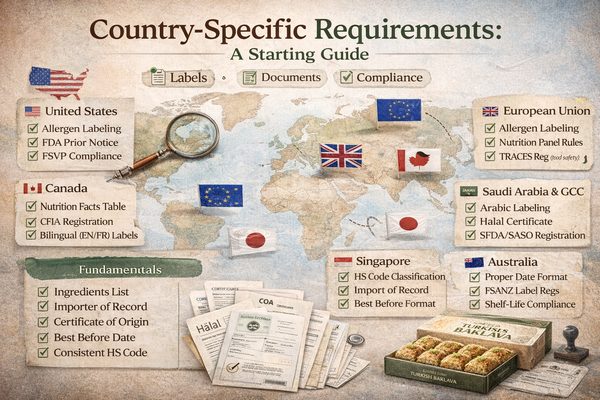
Country-Specific Requirements: A Starting Guide
Baklava Academy • Article 42 • Updated guide for importers, retailers, and hospitality brands.
Key takeaways
- Most problems are preventable: align label + docs + HS code before production.
- Country rules vary mainly on label language, allergens, nutrition format, and importer registrations.
- Use a “single source of truth” spec sheet to keep packaging, COA, and invoices consistent.
- Always validate with the importer/broker before printing thousands of boxes.
1) The five requirements that change by country
- Label language + layout rules (what must be on-pack; font size/placement; sticker allowances).
- Allergen declaration (wording, emphasis, “may contain” rules, nut specificity).
- Nutrition panel format (mandatory fields, serving size conventions, units, rounding).
- Date marking (best before vs expiry, required format, production date/lot code expectations).
- Registrations/certificates (importer registration, facility registration, halal/health certificate requirements).
2) “Baseline” label elements (build once, then localize)
- Product name + clear variant (e.g., pistachio baklava)
- Net weight (and unit expectations)
- Ingredients list (descending order) + additives if applicable
- Allergen statement (nuts, dairy, gluten)
- Nutrition facts (per serving / per 100g as required)
- Best before / production date + lot/batch code
- Storage instructions (temperature/humidity guidance)
- Country of origin + manufacturer/exporter details
- Importer details (if required by destination)
3) Documents: what most brokers will ask for
- Commercial invoice (matching product names, HS codes, values, Incoterms)
- Packing list (carton counts, net/gross weights, pallet details)
- Certificate of origin (often requested; sometimes mandatory)
- Product spec sheet (ingredients, allergens, shelf life, storage)
- COA / lab tests (when required by buyer or authority)
- Health/Sanitary certificate (market-dependent)
- Halal certificate (market/buyer-dependent)
4) Common country “gotchas” (avoid these)
- Mismatch between label and invoice (product name, weight, ingredient terms).
- Wrong HS code or inconsistent HS across documents.
- Date format confusion (DD/MM vs MM/DD) leading to holds or relabeling.
- Missing importer details on-pack where required.
- Sticker relabeling rules (some markets allow it; some restrict it).
5) A simple workflow that works (export teams love this)
- Pick destination + channel (retail vs hospitality vs e-comm).
- Build a one-page compliance spec (label language, allergens, nutrition, date marking, required docs).
- Get importer/broker sign-off on the spec.
- Lock packaging artwork (or sticker plan if allowed) + finalize carton/pallet plan.
- Pre-alert documents to broker before departure.
Copy/paste checklist
- Destination country: ________
- Required label language(s): ________
- Allergen statement wording approved (Y/N): ___
- Nutrition format approved (Y/N): ___
- Date marking format approved (Y/N): ___
- Importer details required on-pack (Y/N): ___
- Certificates required: CO / COA / Health / Halal / Other: ________
- HS code confirmed by broker (Y/N): ___
- Sticker relabeling allowed if needed (Y/N): ___
Related reads: Customs Clearance Basics for Food Imports • Shipping by Air vs. Sea • Export Packaging