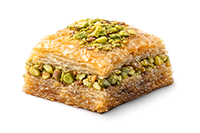

Gaziantep Pistachios 101: Quality, Color, Aroma
This is the pistachio guide that buyers wish existed: what “good” means, how to test it, what can go wrong in shipping, and how to protect the nut’s aroma and color so your baklava still tastes premium after delivery.
Key takeaways
- “Green” isn’t enough. Premium pistachio quality is a combination of aroma intensity, clean flavor, low bitterness, and stable color after baking.
- Freshness is the hidden premium. The biggest enemy is oxidation (stale, paint-like, cardboard notes). Control oxygen + heat + time.
- Color performance matters. Some pistachios look green raw but brown after baking or when syrup touches them—buyers notice immediately.
- Specify the pistachio form. Whole, chopped, “powder,” paste, or mix—each behaves differently and needs different packaging.
- Export success is a system. Roasting method, cooling, storage, packaging barriers, and lot traceability determine whether your pistachio stays premium in transit.
On this page
- Why Gaziantep pistachios are prized (and what that means in exports)
- What “premium pistachio” means for baklava
- Color: what buyers see vs what baklava needs
- Aroma: how to evaluate intensity and freshness
- Forms and cuts: whole, chopped, powder, paste
- Common defects and how they show up in your product
- Sampling & acceptance: a simple importer test protocol
- Storage, packaging, and oxidation control
- Copy-paste spec sheet for RFQs
- FAQ (buyer questions)
Why Gaziantep pistachios are prized (and what that means in exports)
Gaziantep (often called “Antep” in food culture) is strongly associated with pistachio-forward baklava. For export buyers, “Gaziantep pistachio” usually signals: strong aroma, rich flavor, and an interior color that can deliver a premium appearance in finished baklava.
But here’s the export reality: origin does not automatically guarantee performance. A great pistachio can arrive dull if it’s old, poorly stored, over-roasted, or exposed to oxygen and heat. That’s why professional sourcing is about origin + handling + documentation.
The importer mindset
Your customer pays for “fresh pistachio aroma” and “beautiful green appearance.” Your job is to make sure the pistachio still delivers those cues after shipping, warehousing, and retail display.
What “premium pistachio” means for baklava
Pistachios can be high quality for snacking but still perform poorly in baklava. Baklava exposes nuts to heat (baking), fat (butter), and syrup (moisture + sugar). The pistachio must keep its identity through all three.
Premium pistachio for baklava = 5 pillars
- Aroma intensity: the nut should smell “alive”—sweet, nutty, pistachio-forward, not neutral.
- Clean flavor: rich pistachio taste, low bitterness, no “earthy/old” aftertaste.
- Color stability: green-to-emerald interior that stays attractive after baking and syrup contact.
- Uniformity: consistent size/cut, minimal dust, minimal shell fragments, predictable distribution in product.
- Freshness/oxidation control: the nut must resist stale notes through storage and shipping.
What buyers often confuse
- Bright green ≠ fresh. Some nuts look green but have weak aroma due to age.
- Strong roast aroma ≠ pistachio aroma. Heavy roasting can mask pistachio character and increase bitterness.
- Fine “powder” ≠ premium. Very fine grind can oxidize faster and lose aroma sooner.
Color: what buyers see vs what baklava needs
Color sells first. Especially in gifting and premium retail, customers visually judge pistachio baklava in seconds. Your goal is not “neon green” but natural, appetizing green with stability.
Color performance in baklava
- After baking: pistachio should not turn muddy brown or gray-green.
- After syrup contact: the nut should remain vibrant and not bleed color into syrup.
- After display time: color should not fade rapidly under light and warm conditions.
Common color failures (and what they usually mean)
- Brownish or olive tone: oxidation, older stock, or high heat exposure.
- Gray-green / dull: humidity exposure, long storage, or poor barrier packaging.
- Uneven color: mixed grades, inconsistent sourcing, or blending lots to hit a price target.
Practical buyer tip: request a “baked performance sample”
Ask your supplier to provide photos or a test sample of pistachio after baking (and ideally after syrup contact). Many disputes happen because the pistachio looks great raw but performs poorly in finished baklava.
Aroma: how to evaluate intensity and freshness
Aroma is the premium signature. If pistachio aroma is weak, baklava tastes “just sweet.” If aroma is strong and clean, even a small bite feels luxurious.
Simple aroma test (importer-friendly)
- Warm the sample slightly in your hand (closed fist) for 10–15 seconds.
- Smell immediately after opening your hand: premium pistachio jumps out fast.
- Chew 2–3 pieces and note the finish: it should be clean and nutty, not bitter or waxy.
- Wait 30 seconds: premium aroma lingers pleasantly; oxidized nuts leave stale or “paint-like” notes.
Red flags (oxidation and mishandling)
- Cardboard / stale oil notes
- Paint / varnish hints (classic oxidation signal)
- Harsh bitterness that grows after swallowing
- Muted smell despite green appearance
Forms and cuts: whole, chopped, powder, paste
Pistachio isn’t a single ingredient—its form changes everything: distribution, aroma release, oxidation speed, and even syrup behavior. Make sure your supplier quote matches the form you need.
Which form should you choose?
- Whole kernels: best for premium topping and visual impact; slower oxidation; higher cost; needs uniform sizing.
- Chopped kernels: best for classic pistachio baklava fill; balanced performance; watch for dust and uneven cuts.
- Fine “powder”: strong initial color impact but oxidizes fast; best used fresh and protected; ideal for finishing garnish when turnover is fast.
- Pistachio paste: common in filled styles; requires strict fat/oxidation control; must be stable in storage and not separate.
- Blends: a supplier may blend grades to hit cost—demand transparency and define acceptable ranges.
Export note: the finer the cut, the faster the aroma fades if packaging is weak. If you ship long routes or store longer, prefer chopped over ultra-fine powder unless your packaging is truly high barrier.
Common defects and how they show up in your product
Pistachio issues are often invisible on arrival and only appear after baking, syrup contact, or a week on retail shelves. These are the failure modes to watch:
1) Oxidation (stale flavor)
The most expensive defect—because it ruins premium positioning. Often caused by old stock, warm storage, or exposure to oxygen/light. In baklava, it shows as a flat taste with a stale aftertaste that customers describe as “old” or “oily.”
2) Over-roasting (bitterness + brown tone)
Over-roasting can create a toasted smell that seems attractive at first, but it can mask pistachio aroma and add bitterness. It can also darken the nut and reduce the “fresh green” premium look.
3) Moisture issues (soft texture, clumping, mold risk)
Moist pistachios can clump, lose crunch, and become unstable. In baklava, moisture issues can accelerate syrup migration and reduce crispness. Moisture control is both a quality and food safety concern—handle seriously.
4) Dust and fines (visual mess, faster oxidation)
Too much dust can stain syrup, look messy on trays, and oxidize quickly. It also makes portion control harder and increases product-to-product variation.
5) Foreign material (shell, hard fragments)
Shell fragments and hard particles create a safety and customer experience risk. Define acceptable limits and insist on screening controls.
Sampling & acceptance: a simple importer test protocol
If you want consistent quality across shipments, you need a repeatable method. The goal isn’t to be “scientific”—it’s to avoid subjective arguments like “this is still good.”
A practical 3-step protocol
- Arrival check (raw pistachio): aroma test + quick visual uniformity scan + check for dust/shell fragments.
- Use-case test (baklava simulation): bake a small sample (or request supplier baked sample) and check color stability and aroma after heat.
- Hold test (7–10 days): store sealed at your typical warehouse temperature; re-check aroma and any stale notes.
Tip: Keep a “gold standard” reference sample (frozen and sealed) so your team can compare new lots against an agreed benchmark.
Storage, packaging, and oxidation control
Pistachios are high-value and sensitive. Export-grade handling is about controlling four enemies: oxygen, heat, light, and humidity.
Best practices for exporters and importers
- Barrier packaging: sealed packaging that reduces oxygen and moisture exchange.
- Cool storage: stable cool temperatures preserve aroma and reduce oxidation speed.
- Light control: avoid clear packaging for long exposure; light contributes to quality loss over time.
- Batch discipline: lot coding + FIFO prevents “mystery blending” and old stock issues.
- Separate strong odors: nuts can absorb odors; store away from spices, detergents, and scented materials.
Export warning: “green today” can be “dull next month”
The market remembers aroma and color loss far more than it remembers a low price. If your route is long or your retail turnover is slow, build your spec around stability, not just initial appearance.
Copy-paste spec sheet for RFQs (pistachio for baklava)
Use this section to standardize supplier offers. Replace placeholders with your market needs.
Pistachio specification template
- Origin preference: Gaziantep / Southeastern Türkiye (or “Gaziantep-style profile”).
- Form: whole kernels / chopped / fine powder / paste (select one).
- Target use: filling / topping / mix (specify).
- Color expectation: natural green-to-emerald interior; stable after baking; minimal browning.
- Aroma expectation: strong pistachio-forward aroma; no stale/paint notes; low bitterness.
- Cleanliness: minimal dust; screening for shell fragments; acceptable defect tolerance defined.
- Packaging: high-barrier sealed packaging suitable for export; outer carton crush protection if applicable.
- Traceability: lot/batch code, packing date, best-before, production origin statement, documentation as required.
- Testing: supplier provides sample + (optional) baked performance sample; importer performs arrival + hold test.
FAQ (buyer questions)
What’s the fastest way to spot low-quality pistachios?
Aroma and aftertaste. If it smells muted or leaves stale/paint-like notes, it’s not premium. Color alone is not a reliable indicator.
Do greener pistachios always mean better baklava?
Not always. Some look green raw but perform poorly after baking or syrup contact. Ask for baked performance proof and focus on aroma + stability.
Is chopped pistachio better than powder for export?
Often yes for long routes. Powder oxidizes faster and loses aroma sooner unless packaging and turnover are excellent. Chopped kernels give a good balance of distribution and stability.
Why does pistachio sometimes taste bitter?
Bitterness can come from over-roasting, oxidation, mixed grades, or poor storage. Define acceptable bitterness in sample approvals and keep storage cool and sealed.
How should I store pistachio-heavy baklava in my warehouse?
Cool and dry, away from heat sources and strong odors. Maintain sealing discipline, use FIFO, and avoid warm retail displays that accelerate aroma loss and syrup migration.
Continue the Academy series
If you share your destination country and channel (retail/hospitality), we can recommend the pistachio profile and packaging strategy best suited to your route.