Phyllo vs. yufka: what buyers should actually care about
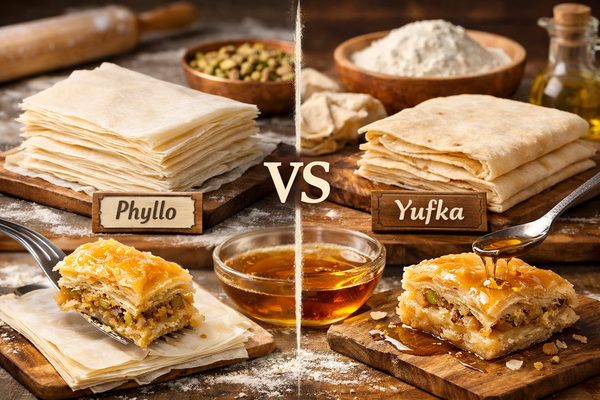
In real-world trade, “phyllo” usually signals ultra-thin pastry sheets. “Yufka” is broader: it can mean anything from thin baklava-grade sheets to thicker savory sheets. For export programs, focus on measurable performance and repeatability.
Key takeaways
- Thickness drives texture: thinner sheets = lighter crunch and clearer layers when syrup is controlled.
- Uniformity beats terminology: consistent sheet size, thickness, and moisture matter more than the name.
- Syrup behavior is the test: good dough stays crisp on top and not gummy inside after syruping.
- Export adds pressure: humidity, vibration, and time punish weak layering and uneven moisture.
On this page
Definitions (practical, not academic)
Phyllo (filo): commonly used to describe very thin, delicate sheets designed for layered pastries. It dries fast, tears easily if mishandled, and rewards skill with crisp, distinct layers.
Yufka: a Turkish umbrella term for rolled-out dough sheets. Depending on the product, it can be thin enough for baklava-style layering or thicker and more elastic for savory uses. This is why “yufka” on its own is not a spec.
How dough choice changes the final baklava
1) Layer definition
- Thinner, consistent sheets: clearer flake + “shatter” crunch.
- Thicker/uneven sheets: more chew and higher risk of gummy pockets after syrup.
2) Syrup absorption window
- Premium behavior: syrup soaks without collapsing layers; top stays crisp longer.
- Problem behavior: syrup pools or concentrates → soggy bottoms, sticky centers.
3) Handling and production consistency
- Ultra-thin sheets require strong process control: humidity, timing, and skilled handling.
- More elastic sheets can be easier to handle—but may change texture and syrup outcomes.
Export risks: humidity, sogging, and breakage
Export routes magnify small weaknesses. If sheets vary by thickness or moisture, you’ll see it after shipping: edges soften first, then centers become dense or sticky.
What “export-ready” dough performance looks like
- Stable crispness: top stays crisp, not leathery, under normal storage.
- No gummy zones: center layers are flaky, not pasty.
- Breakage resistance: slices hold structure and don’t crumble into dust with vibration.
How to evaluate suppliers and batches (fast, buyer-friendly)
Ask these questions (they reveal process control)
- Are sheets produced in-house or sourced from a dough supplier?
- How is sheet thickness controlled and monitored?
- How do you prevent drying during assembly (humidity/time controls)?
- What is your target outcome after syruping: crisp top, layered bite, no gumminess?
- What changes for air vs sea shipments (packaging / storage recommendations)?
Arrival + 7-day hold test
- Arrival: check layer definition, top crispness, bottom dryness, and slice integrity.
- Day 7: check softening, gumminess, syrup pooling, and packaging humidity effects.
- Score each supplier with the same rubric for apples-to-apples comparison.
Copy-paste RFQ spec (dough + performance)
Use this to avoid “phyllo vs yufka” confusion and force comparable offers.
RFQ template
- Dough requirement: baklava-grade ultra-thin layered sheets (consistent thickness and moisture)
- Performance targets: crisp top; defined layers; no gummy centers after syrup
- Export targets: minimal softening and no syrup pooling after arrival + 7-day hold
- Consistency: batch-to-batch repeatability; provide production date + lot info
- Allergens/labeling: wheat/gluten statement; any additives/enzymes clearly declared
- Packaging: crush protection + humidity control appropriate for route (air/sea)
FAQ
If a supplier says “yufka,” should I avoid it?
Not automatically. “Yufka” can be excellent or inappropriate depending on thickness and purpose. Ask for performance outcomes (layer clarity, crispness retention, syrup behavior) and verify via hold testing.
What’s the quickest way to spot low-grade dough in finished baklava?
Look for uneven thickness (some slices dense), gummy centers after syrup, and fast softening—especially at the edges—during storage.
How does butter choice interact with dough type?
Butter (especially clarified butter / sade yağ) helps separate layers and supports crispness. Weak dough + excess moisture makes oil migration and sogging more likely in export conditions.
Continue the Academy series
Share your destination climate, route (air/sea), and preferred texture. We’ll recommend the right dough + syrup + packaging setup.