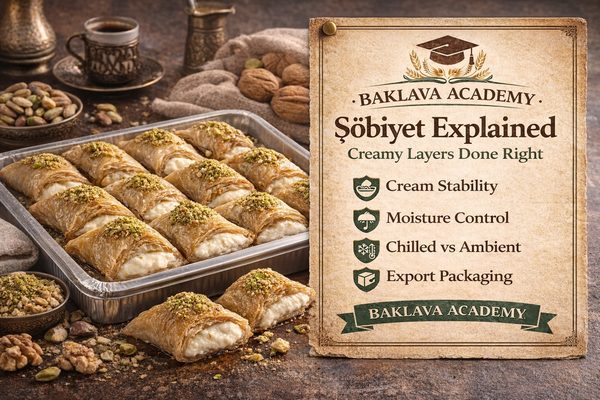
Şöbiyet Explained: Creamy Layers Done Right
Şöbiyet is a premium “specialty” item in many export assortments. It can increase average order value—but only if it arrives with a stable cream texture and crisp layers. The importer’s job is to manage three enemies: heat, moisture migration, and weak packaging.
Key takeaways
- Şöbiyet is more sensitive than classic baklava: the creamy filling can soften layers and drift in texture over time.
- Export route choice matters: chilled logistics or fast air shipping often protects quality better than slow ambient routes.
- Premium cues are clear: smooth cream, clean butter aroma, crisp edges, no syrup pooling, and fresh pistachio finish.
- Batch grading must include a hold test: evaluate on day 1 and again after storage to detect sogginess and separation.
- Packaging is not optional: strong inner sealing + rigid trays reduce leakage, crushing, and aroma loss.
On this page
- What şöbiyet is (and what “good” looks like)
- Flavor & texture targets for premium şöbiyet
- The 4 biggest export risks (and how to spot them)
- Ambient vs chilled export: choosing the right route
- How importers grade şöbiyet batches
- Packaging that prevents sogginess and leakage
- Retail handling guidelines you can share with buyers
- Copy-paste RFQ spec template
- FAQ
What şöbiyet is (and what “good” looks like)
Şöbiyet (often written “Şöbiyet” or “Sobiyet”) is a filled baklava style that combines phyllo layers, syrup, and nuts—plus a creamy dairy-based filling (commonly a semolina-style cream). That filling is the differentiator and also the risk: it introduces moisture and texture sensitivity.
Premium şöbiyet should look like
- Defined shape: pieces hold their form; folds are neat; edges aren’t collapsed.
- Clean cream pocket: cream is visible, creamy (not watery), and stays in place.
- Gloss without pooling: syrup sheen on top, but no sticky puddles in the tray.
- Golden bake: even bake color; not pale (undercooked) or dark (burnt notes).
- Neat pistachio garnish: fresh green color, not dull or greyish.
Buyer reality
If your route is warm or slow, şöbiyet needs stricter specs than standard baklava. A supplier that makes amazing şöbiyet for local same-day sale may not be export-ready without packaging and process adjustments.
Flavor & texture targets for premium şöbiyet
The ideal şöbiyet experience is a contrast: crisp layers, light syrup sweetness, nut aroma, then a creamy finish. When it’s wrong, everything collapses into “sweet mush.” Here’s what to target:
Taste & aroma (what customers remember)
- Cream note: milky and clean, not sour, not “cooked milk,” not starchy.
- Butter aroma: warm bakery butter note that supports, not a heavy oily finish.
- Pistachio lift: fresh nut aroma on top and in bite; no stale or dusty notes.
- Sweetness balance: sweet but not cloying; cream should reduce perceived sweetness.
Texture (where premium is won or lost)
- Top crispness: surface breaks cleanly (not chewy).
- Layer definition: phyllo layers remain distinct—not fused into a wet cake.
- Cream texture: smooth and stable; not grainy; not watery; no separation.
- Clean mouthfeel: creamy finish, not greasy, not sticky.
The 4 biggest export risks (and how to spot them)
1) Soggy layers (moisture migration)
Cream and syrup can migrate into the phyllo over time, especially if packaging allows humidity exchange or if the product warms up. The result is “soft,” “chewy,” or “wet” layers.
- Spot it: top loses crispness; pieces feel heavier; bottom layers compress.
- What it signals: too much syrup, weak bake, cream too wet, or temperature abuse.
2) Cream separation or watery pockets
A cream filling that separates will leak moisture into layers and leave an unpleasant mouthfeel.
- Spot it: watery sheen near cream pocket; cream looks broken; liquid collects in tray.
- What it signals: formulation instability, poor cooling, or warm storage.
3) Syrup leakage and sticky trays
Leakage reduces shelf appeal and makes the product feel “messy,” especially in premium retail.
- Spot it: syrup pooled in corners; outer cartons show stains; pieces slide.
- What it signals: syrup ratio too high, weak sealing, or rough handling.
4) Heat damage (aroma fade + oil migration)
Heat accelerates every failure mode: sogginess increases, cream drifts, fats migrate, and aroma fades.
- Spot it: oily marks on liner; muted pistachio aroma; heavy greasy finish.
- What it signals: route too warm, warehousing issues, or insufficient barrier packaging.
Importer “route simulation” test
- Evaluate on arrival (day 1): crispness, cream texture, syrup pooling, aroma.
- Store sealed for 3–7 days under typical warehouse conditions.
- Re-check: if layers soften fast or cream separates, the product may require chilled shipping or tighter specs.
Ambient vs chilled export: choosing the right route
Unlike classic baklava, şöbiyet is often best treated as a specialty item with stricter logistics. You can export it in two main ways:
Option A: Fast ambient (air) for premium texture
- Best for: premium retail, gifting, high-end cafes.
- Why it works: short transit reduces moisture migration and cream drift.
- Trade-off: higher logistics cost; smaller shipment sizes.
Option B: Chilled/cold-chain for stability-focused programs
- Best for: consistent quality programs, larger distribution, sensitive climates.
- Why it works: reduces heat-driven failure modes and preserves cream texture.
- Trade-off: requires cold-chain discipline and appropriate receiving/storage at destination.
Practical recommendation: If your destination frequently experiences warm warehousing or long last-mile delivery, consider exporting şöbiyet only in smaller “specialty” quantities—unless chilled handling is guaranteed.
How importers grade şöbiyet batches
Şöbiyet grading must separate “looks good today” from “stays good through the route.” Importers grade using a two-stage evaluation: arrival scoring + hold test.
Premium cues (score high)
- Cream is smooth: stable texture, no graininess, no watery edges.
- Layers stay crisp: top and edges break cleanly.
- Syrup is controlled: glossy without pooling; no sticky puddles.
- Aroma is clean: butter + pistachio are present; no sour dairy note.
- Presentation holds: pieces don’t collapse; tray stays neat.
Defects (score down / reject for premium channel)
- Sour or “old dairy” note (even slight)
- Watery separation near the cream pocket
- Rapid softening during hold test
- Leakage that stains liners/cartons
- Greasy finish and aroma loss after warm exposure
Simple scoring sheet (example)
- Cream texture: smooth / slightly grainy / separated
- Crispness: crisp / acceptable / soft
- Syrup: balanced / heavy / pooling
- Aroma: clean / muted / off-note
- Stability after hold: stable / minor drift / failed
Packaging that prevents sogginess and leakage
Packaging for şöbiyet has two jobs: protect structure and protect texture. Because cream can soften layers, the inner barrier and tray rigidity matter more than with classic baklava.
Packaging priorities
- Rigid tray support: prevents collapse and corner damage.
- Strong inner barrier: reduces humidity exchange and helps preserve crispness.
- Leak-resistant liner: helps manage syrup/oil marks and keeps cartons clean.
- Carton fit: minimal headspace reduces sliding and crumbling.
Arrival checks for packaging issues
- Any sticky corners? indicates pooling/leakage risk.
- Any oily stains? indicates heat exposure or fat migration.
- Any crushed edges? indicates weak tray/carton or poor palletization.
Retail handling guidelines you can share with buyers
A premium şöbiyet can be ruined by poor receiving and display. Many importers add a simple handling card for buyers.
Suggested handling notes (copy for your buyers)
- Store sealed until display to protect crispness.
- Avoid heat sources (sunlight, warm shelves, near ovens/coffee machines).
- Rotate stock FIFO and keep cartons dry and odor-free.
- If chilled product: maintain cold chain and avoid repeated temperature cycling.
- Serve at comfortable temperature for best cream texture and aroma.
Copy-paste RFQ spec template (şöbiyet)
Use this to request comparable quotes and reduce quality surprises across suppliers.
RFQ template
- Product: Şöbiyet (cream-filled baklava), specify piece shape/weight and tray size
- Filling: stable creamy dairy-based filling; smooth texture; no separation during hold test
- Nuts: pistachio grade requirements; garnish color targets (fresh green, not dull)
- Syrup: glossy, absorbed; no pooling or leakage; balanced sweetness
- Texture target: crisp top/edges; layers remain defined for intended shelf life
- Labeling: allergens (nuts/dairy/gluten), storage conditions, batch/lot code, production date
- Route: state if ambient air or chilled; request recommended handling instructions
- Packaging: rigid tray + sealed inner barrier + export carton; request packaging layer photos
- Testing: importer route simulation 3–7 days for separation/softening
FAQ
How is şöbiyet different from classic baklava?
The cream filling changes everything: it adds softness and richness, but also increases risk of sogginess and stability issues during shipping. That’s why grading and packaging must be stricter.
What’s the #1 sign a şöbiyet lot is not export-ready?
Watery separation or rapid softening during a short hold test. If it looks great on day 1 but turns soft and wet quickly, it will struggle on longer routes or warm climates.
Is chilled logistics always required?
Not always, but it depends on your destination climate, warehousing, and last-mile realities. Many importers use fast air shipments for premium channels, and chilled programs for consistent distribution.
How do I position şöbiyet in a product range?
Position it as a specialty: “creamy, luxurious, and pistachio-forward.” It often increases basket size when offered in mixed trays or as a limited seasonal item.
Continue the Academy series
Tell us your destination, route (air/sea), and whether chilled receiving is available. We’ll recommend the most stable şöbiyet options for your program.