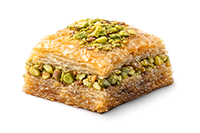

Kadayif Desserts: Tel Kadayif vs. Künefe
Buyers often lump these together—but they behave very differently in storage, shipping, and serving. Below is a practical guide to quality grading, supplier evaluation, and export considerations for each product.
Key takeaways
- Tel kadayif is typically export-friendly: crisp shredded pastry + nuts + syrup, similar risk profile to baklava.
- Künefe is a service-driven dessert: shredded pastry + cheese melt; best when served hot and often requires refrigerated or frozen logistics.
- Quality hinges on texture: tel kadayif should stay crisp and aromatic; künefe should melt smoothly with clean dairy taste and controlled oil release.
- Packaging must match the physics: humidity softens kadayif, heat accelerates oil migration, and temperature swings can cause syrup seepage.
- Choose by channel: retail trays vs. foodservice “bake-and-serve” formats need different specs.
On this page
- What is kadayif (and why it’s different from filo baklava)
- Tel kadayif vs. künefe: quick comparison
- How to grade premium tel kadayif
- How to grade premium künefe
- Export reality: shelf life, humidity, and temperature
- Packaging strategies: crush, humidity, seepage, oil migration
- Copy-paste RFQ spec templates
- FAQ (buyer questions)
What is kadayif (and why it’s different from filo baklava)
“Kadayif” refers to a thin, shredded pastry (often described as hair-like strands) used in multiple desserts. Compared to filo baklava, kadayif has more air pockets and strand-to-strand structure, which means: it can be wonderfully crisp—but it can also absorb humidity quickly if packaging is weak.
In practical export terms: kadayif desserts are less about ultra-thin layered sheets and more about strand crispness, butter aroma, even syrup absorption, and structural integrity during transport.
Tel kadayif vs. künefe: quick comparison
They start with similar pastry strands, but the product goal is different: tel kadayif is nut-and-syrup crispness; künefe is hot cheese melt with syrup and a browned crust.
Buyer-facing comparison (what matters in export)
- Core identity: Tel kadayif = crispy strands + nuts. Künefe = crispy crust + melted cheese stretch.
- Best served: Tel kadayif can be served room temperature. Künefe is ideally served hot.
- Logistics complexity: Tel kadayif is simpler. Künefe often needs refrigerated/frozen handling depending on format.
- Main failure risk: Tel kadayif = humidity softening + syrup imbalance. Künefe = cheese separation/grease + texture collapse.
- Typical channels: Tel kadayif: retail trays, cafes, gifting. Künefe: restaurants, hotels, dessert bars, premium foodservice.
How to grade premium tel kadayif
Premium tel kadayif should feel crisp and light, not dense or soggy. It should carry a clean butter aroma and fresh nut character, with syrup present but not heavy.
What “premium” tastes and feels like
- Texture: crisp strands with a delicate snap; interior stays airy (not compressed).
- Syrup balance: absorbed and glossy; no pooling; sweetness doesn’t dominate.
- Aroma: clean butter note + nut aroma; no stale/oxidized nut smell.
- Nut distribution: even and generous where promised (top and/or inside), without dusty mess.
- Appearance: uniform browning; not pale (underbaked) and not dark/bitter (overbaked).
Tel kadayif defects (and what they usually mean)
- Soggy bite: humidity exposure, weak packaging, syrup too much or added too warm.
- Sticky-heavy finish: syrup imbalance or insufficient cooling before packing.
- Stale nut aftertaste: nut oxidation (old stock or poor storage) or overly fine grind.
- Burnt/bitter notes: overbake, hot spots, or excessive browning in production.
- Crumb explosion: product too dry/brittle or packaging lacks crush protection.
Importer test: “Crispness retention”
Score tel kadayif on arrival, then store sealed for 7–10 days at typical warehouse conditions and re-test. If it collapses into softness quickly, you need better humidity control or a different product format.
How to grade premium künefe
Künefe is judged in motion: the moment it’s hot and cut, the cheese stretch and crust crispness define quality. Great künefe has a browned, crisp exterior and a soft, melted center with clean dairy flavor—without oiliness.
Premium künefe checklist (served hot)
- Crust: browned, crisp, and aromatic; not soggy and not overly hard.
- Cheese melt: smooth melt with satisfying stretch; doesn’t break into rubbery chunks.
- Dairy taste: clean, pleasant, not overly salty, not “barny,” not sour.
- Oil control: no greasy puddle; fat feels integrated, not leaking out aggressively.
- Syrup: present but balanced; complements cheese instead of drowning it.
Künefe defects (common buyer complaints)
- Rubbery or tough cheese: wrong cheese type for melt, overheating, or poor formulation.
- Greasy, heavy mouthfeel: fat separation, temperature abuse, or imbalance in pastry-to-cheese ratio.
- Soggy base: too much syrup, weak crust, or moisture migration during storage.
- Weak cheese stretch: cheese composition and heat management; also can be affected by freezing/thawing cycles.
- Off dairy aroma: cold-chain issues or extended storage beyond intended shelf life.
Foodservice note: künefe is a “process product”
Künefe quality depends on how it is heated and served. If you sell to restaurants/hotels, provide simple heating instructions and define a target serving method (pan/oven) so the result is consistent.
Export reality: shelf life, humidity, and temperature
Tel kadayif and künefe don’t fail for the same reasons. Tel kadayif is mainly a humidity and crush challenge. Künefe is a temperature and cheese stability challenge.
Tel kadayif export risks
- Humidity softening: strands absorb moisture quickly; crispness drops.
- Syrup movement: heat changes can cause seepage or pooling.
- Crush damage: the dessert can crumble if trays and cartons are weak.
- Nut oxidation: especially if topped with fine pistachio “powder.”
Künefe export risks
- Cold-chain dependence: cheese quality and safety depend on proper temperature handling.
- Freeze-thaw stress: can change melt behavior and increase water release.
- Oil separation: can increase with temperature swings and long storage.
- Texture collapse: moisture migration makes crust soggy if packaging and storage are not matched to the format.
Practical rule: if your customer wants “cheese stretch,” treat it like a temperature-controlled product. If your customer wants “crisp nut dessert,” tel kadayif is usually the simpler export choice.
Packaging strategies: crush, humidity, seepage, oil migration
Kadayif desserts are highly sensitive to both physical shock and microclimate inside the box. Your packaging system must protect structure while controlling humidity and oil.
For tel kadayif (export-friendly formats)
- Crush protection: rigid tray + snug fit + corner support reduces crumbling.
- Humidity control: sealed inner layer that limits moisture exchange.
- Syrup management: stable tray base + leak-resistant design to prevent pooling.
- Nut protection: avoid loose fine pistachio without a protective inner film.
For künefe (temperature-sensitive formats)
- Sealed temperature-ready packaging: prevent contamination and odor pickup in cold storage.
- Structure for cheese layer: prevent compression that forces cheese out or deforms the product.
- Oil migration control: inner liners designed for fat contact and stability.
- Clear labeling: storage temperature guidance and best-before for your market.
Buyer test: “Box cleanliness”
On arrival, check inner liners and cartons for oily stains and syrup marks. These are early warning signs that aroma will fade and customer perception will drop.
Copy-paste RFQ spec templates
Use these templates to request consistent quotations from suppliers. The goal is to eliminate vague offers like “premium quality” and replace them with measurable targets.
RFQ template — Tel kadayif
- Product: Tel kadayif (specify nut: pistachio / walnut / mixed)
- Format: tray / slices / mini portions (specify)
- Quality targets: crisp strands, clean butter aroma, fresh nut flavor, no syrup pooling
- Export requirements: minimal breakage, humidity-resistant sealed packaging, oil migration control
- Label needs: ingredients + allergens, net weight, batch/lot code, production date, best-before
- Testing: supplier sample + importer 7–10 day hold test for crispness retention
RFQ template — Künefe
- Product: Künefe (cheese-filled kadayif dessert)
- Format: restaurant-ready portions / retail packs / frozen (specify)
- Cheese targets: clean dairy taste, smooth melt, satisfying stretch, controlled oil release
- Cold chain: confirm storage requirement (chilled/frozen) and route feasibility
- Packaging: sealed, fat-resistant liner, structure to protect cheese layer and crust
- Serving method: provide heating instructions and target result (browned crust + melted center)
- Documentation: batch traceability, temperature handling statement, label compliance
FAQ (buyer questions)
Which is better for retail shelves?
Tel kadayif is usually better for shelf display because it’s served at room temperature and behaves like baklava. Künefe is best when sold as a chilled/frozen or bake-and-serve product with a clear cold-chain plan.
Can künefe be exported without refrigeration?
If the product contains dairy cheese that requires temperature control, plan for refrigerated/frozen logistics. If a supplier offers a shelf-stable format, verify the ingredients, labeling, and intended storage method carefully.
What is the #1 quality signal customers notice?
For tel kadayif: crispness + nut aroma. For künefe: hot cheese melt and clean dairy taste (plus a browned, crisp crust).
What’s the easiest way to compare suppliers?
Use the same scoring checklist, run a hold test for tel kadayif, and for künefe test melt behavior using the same heating method. Also compare packaging cleanliness (oil/syrup marks) on arrival.
Continue the Academy series
Share your destination country, channel (retail/hospitality), and shipping mode (air/sea). We’ll recommend the best kadayif format and packaging strategy for your route.