
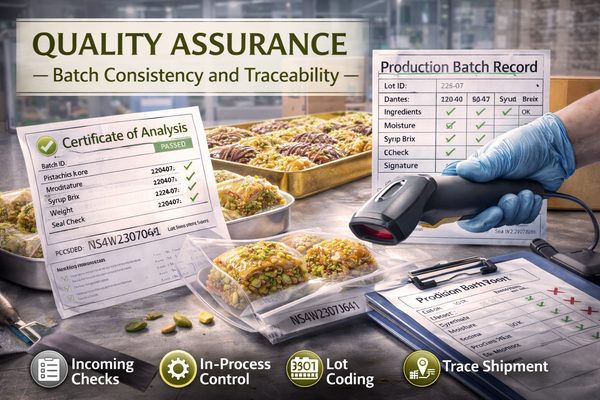
Quality Assurance: Batch Consistency and Traceability
Baklava Academy • Article 31 • Updated guide for importers, retailers, and hospitality brands.
Key takeaways
- Consistency is engineered: define specs, control critical variables, and standardize release decisions.
- Traceability is a system: lot codes + batch records + shipment mapping (not just “a label”).
- Export QA is buyer-facing: clear documentation reduces disputes, delays, and costly rework.
1) Define “premium” in measurable terms
The fastest way to inconsistent baklava is vague language (“good pistachio”, “nice syrup”). Replace that with a simple spec: what “good” looks like on taste, texture, aroma, and appearance—plus what’s acceptable variation.
- Sensory profile: pistachio intensity, butter aroma, sweetness level, aftertaste.
- Texture: crispness, syrup absorption (not dry, not soggy), bite feel.
- Appearance: pistachio color, uniform cut, minimal syrup pooling, clean top finish.
- Pack + count: net weight tolerance, piece count, tray fit, headspace, seal quality.
2) Control the “big four” consistency variables
Most batch variation shows up here first—tighten these and results improve immediately.
- Inputs: pistachio grade and roast, butter/fat profile, phyllo thickness, sugar quality.
- Syrup parameters: concentration (Brix target), temperature at pour, timing, soak time.
- Baking and cooling: bake time/temperature uniformity, cooling environment, condensation risk.
- Packaging: barrier level, sealing consistency, humidity protection, crush protection.
3) Build a simple QA flow (supplier → production → shipment)
A) Supplier approval (before you buy)
- Approve ingredient and packaging suppliers with written specifications and agreed tolerances.
- Require allergen clarity (nuts, dairy, gluten) and labeling compatibility for your target market.
- Define what documentation you’ll receive per lot (e.g., lot codes, dates, origin statements where applicable).
B) Incoming checks (when materials arrive)
- Ingredient ID + lot capture: record supplier lot codes for pistachio, butter/fat, flour/phyllo, sugar.
- Basic condition checks: odor, color, moisture/texture signs, packaging damage.
- Packaging checks: film integrity, tray rigidity, lid fit, carton strength.
C) In-process controls (while making it)
- Weight control: portioning and net weight targets; stop-line triggers if drift is detected.
- Syrup control: consistent prep and application timing (a common source of batch difference).
- Foreign body prevention: practical controls appropriate to the operation (screens, magnets, visual checks).
- Packaging integrity checks: seal inspection at a defined frequency per run.
D) Finished goods release (before shipping)
- Lot code applied and verified on unit + carton + pallet labels.
- Sensory check against your reference standard (even a small panel beats “looks fine”).
- Packaging check: seal, leaks, damage, headspace, and overall presentation.
- Hold-and-release rule: if it’s out of spec, it’s held—no exceptions.
4) Traceability that actually works
Traceability should answer two questions quickly: (1) What went into this batch? and (2) Where did this batch go?
- One-step-back: ingredient lots + packaging lots used in the finished good lot.
- One-step-forward: shipment records showing customers, quantities, and dates for that lot.
- Batch record: production date/time, line/shift, key parameters, checks performed, release decision.
- Shipment mapping: pallet IDs → carton IDs → unit lot codes (as deep as your operation requires).
Stress test it with a mock recall. If you can’t locate affected shipments fast, the system isn’t finished yet.
5) Export-facing documentation importers like
- Spec sheet: ingredients, allergens, net weight, piece count, storage guidance, shelf-life basis.
- Label pack: final approved label artwork + translations (if needed) + lot/best-before format.
- Batch/lot info: production date, lot code logic, traceability statement.
- Quality release pack: internal release checklist and any agreed lab results / COA where applicable.
Practical exporter checklist
- Write 1-page specs for product + packaging (with tolerances).
- Standardize a batch record template (inputs, parameters, checks, release signature).
- Implement consistent lot coding (units + cartons + pallets).
- Record ingredient lot codes for every production batch.
- Run mock recall drills (quarterly or per season) and fix gaps.
- Keep a “golden sample” reference for sensory alignment across batches.
Related reads: Shelf-Life Testing • Export Packaging • Gaziantep Pistachios 101