
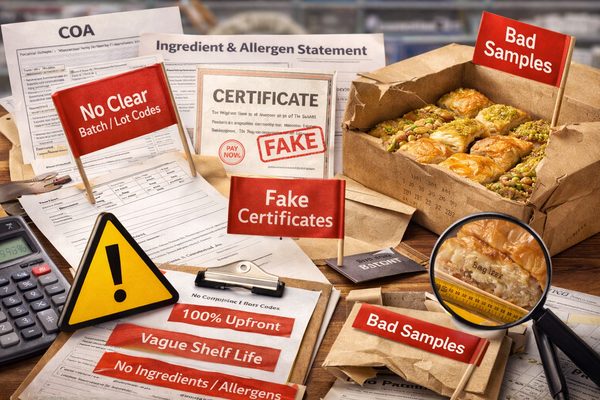
Choosing a Supplier in Turkey: Red Flags to Avoid
Baklava Academy • Article 39 • Updated guide for importers, retailers, and hospitality brands.
Key takeaways
- Red flags cluster: documentation gaps + inconsistent samples + unrealistic promises usually travel together.
- Traceability is non-negotiable: lot codes, dates, and paperwork should match—every time.
- Control the pilot: small first shipment, strict specs, and milestone payments reduce downside.
1) Documentation red flags (the fastest “no”)
- Won’t provide ingredients & allergen statement (or it changes between messages).
- COA is missing, generic, or not lot-linked (no batch/lot number, no date, unclear units).
- No shelf-life statement or vague dating (no production date format, no “best before” policy).
- Labeling is “later” with no approval step; refuses to share label proof before print.
- Inconsistent company identity: invoice name doesn’t match website name, bank account name differs, or addresses move.
2) Product & quality red flags (what you taste becomes what you fight about)
- Samples don’t match repeat samples (color, pistachio density, syrup level, aroma) with no explanation.
- Cannot define product spec: net weight tolerance, piece count, nut ratio (if claimed), or moisture/texture targets.
- Overpromises on shelf life without packaging and route testing.
- “Premium” without proof: no clarity on pistachio type/grade or butter/fat source.
- Reluctant to do a controlled pilot (wants full container/large MOQ immediately).
3) Packaging & logistics red flags (silent quality killers)
- Weak outer carton (no crush resistance spec, no clear pallet pattern, no corner protection).
- No humidity strategy: no inner barrier, no liner, no desiccant option for humid routes.
- Doesn’t ask about your destination (temperature, seasonality, clearance timing, warehousing).
- Vague lead time or “always ready tomorrow” despite production reality.
4) Commercial & payment red flags (fraud and disputes)
- Pressure for 100% upfront on first order with no verification steps.
- Refuses milestone payments tied to label approval, COA, or pre-shipment evidence.
- Bank details keep changing, or the beneficiary name doesn’t match the contracting entity.
- Unrealistic pricing far below market—often indicates ingredient substitution or weak export packaging.
5) What “good” looks like (green flags)
- Shares a clean product spec + ingredients/allergens quickly, and it stays consistent.
- Provides lot-linked COA samples and explains test items/units.
- Has a label approval step and protects brand consistency.
- Suggests a pilot shipment and helps you test your route (air/sea, season).
- Comfortable with pre-shipment photo/video proof and carton/pallet specs.
Copy/paste: supplier vetting checklist (fast)
- Legal entity + invoice/bank match (Y/N): ___
- Ingredients + allergen statement provided (Y/N): ___
- COA sample is lot-linked and readable (Y/N): ___
- Packaging spec: inner barrier + outer carton + pallet plan (Y/N): ___
- Dating: production date + best before + lot coding (Y/N): ___
- Pilot order accepted with defined specs (Y/N): ___
- Milestone payment acceptable (Y/N): ___
Related reads: Contracting & Payment Terms • How to Read a COA • Shipping by Air vs. Sea