Pricing Baklava for Export Markets
Baklava Academy • Article 29 • Updated guide for importers, retailers, and hospitality brands.
Key takeaways
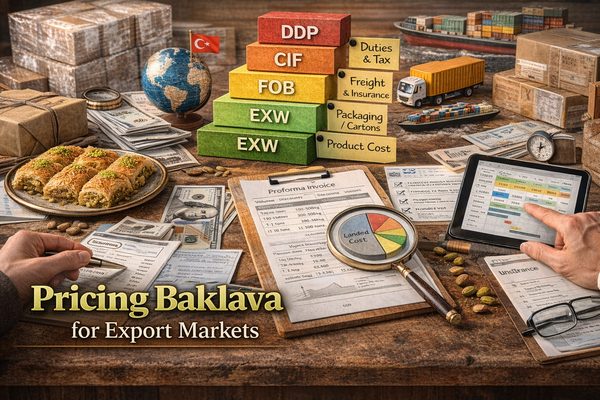
- Price in the right Incoterm (EXW/FOB/CIF/DDP) so buyers can compare fairly.
- Model landed cost per kg and per unit to protect margin and shelf-price targets.
- Separate “product value” from “logistics cost”—especially when freight is volatile.
1) Start with the pricing question that matters
Before quoting, define which decision you’re optimizing for:
- Wholesale/distributor: competitive landed cost and reliable supply.
- Retail: shelf price architecture (good/better/best) and promo flexibility.
- HORECA: consistent piece size, predictable yield, and back-of-house handling.
- Private label: total program cost (artwork, printing, compliance) and repeatability.
2) Quote cleanly with Incoterms (avoid apples-to-oranges)
Use one base price and then add layers—don’t mix everything into a single “all-in” number unless requested.
- EXW: buyer arranges pickup; best for clean product comparison.
- FOB: includes delivery to port and export formalities; common for international buyers.
- CIF: includes ocean freight + insurance to destination port (not inland delivery).
- DDP: delivered with duties/taxes paid; simplest for the buyer, hardest to execute consistently.
3) Build a simple landed-cost stack
Use a spreadsheet-friendly stack for each SKU:
- Product price (EXW or FOB)
- Export packing (cartons, inner trays, film, desiccant if used)
- Palletization (pallet, corner boards, stretch wrap)
- Freight + insurance (air/sea, seasonal volatility)
- Destination handling (port/terminal, unloading, storage fees if any)
- Customs & taxes (duty, VAT/GST where applicable)
- Clearance + inland delivery (broker fees, trucking to warehouse)
- Loss/shrink allowance (breakage, humidity damage risk, returns policy)
Always calculate both per kg and per retail unit. A “good” kg price can still fail once unit economics are applied.
4) Price bands: how to structure your assortment
Importers sell more when the assortment supports clear tiers:
- Core premium: the volume driver (consistent pistachio and butter profile).
- Signature/premium+: higher pistachio ratio, special cuts, gift-ready packaging.
- Program/foodservice: stable spec, larger formats, efficiency-focused packing.
In quotes, keep tiers explicit so buyers understand what changes between levels (pistachio grade, filling %, butter profile, packaging format).
5) Volume discounts that don’t destroy margin
- Reward logistics efficiency: bigger runs of fewer SKUs are cheaper than many small SKUs.
- Tier discounts by pallet/container, not by “wishful” annual volume.
- Separate one-time setup costs (private label artwork plates, printing setup) from ongoing unit prices.
6) Protect yourself from FX and freight volatility
- Quote validity window: define how long the offer is valid.
- Freight as a pass-through: keep product price stable and update freight at booking.
- Payment terms: align terms (TT/LC) with your risk tolerance and working capital.
Pricing checklist
- Choose the quoting basis (EXW/FOB/CIF/DDP) and state it clearly.
- Confirm SKU specs that change cost (pistachio grade, butter/fat profile, piece size, packaging).
- Compute landed cost per kg and per unit; validate against target shelf price and channel margin.
- Define discount tiers tied to pallets/containers and SKU simplicity.
- Set quote validity, expected lead time, and substitution rules (if any).
Related reads: Lead Times • Export Packaging • Quality Assurance