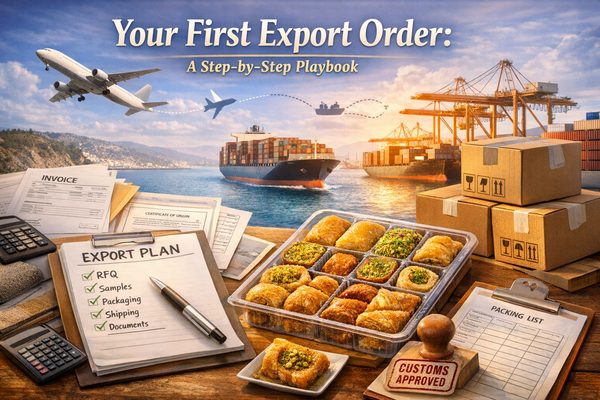
Your First Export Order: A Step-by-Step Playbook
Baklava Academy • Article 50 • Updated guide for importers, retailers, distributors, and hospitality brands.
Why first orders fail (and how to prevent it)
First shipments usually go wrong for simple reasons: vague specs, packaging that looks premium but isn’t export-strong, route choices that ignore heat/humidity, or paperwork that starts too late. The fix is a repeatable process. Treat this playbook as your “minimum viable export workflow” — once you run it once, your second order becomes faster, cheaper, and far more predictable.
Table of contents
- Key takeaways
- Step-by-step export workflow
- Copy/paste RFQ template
- Quality specs buyers should lock
- Export packaging selection (crush + crunch)
- Shipping plan: air vs sea, ambient vs cold chain
- Incoterms and responsibilities (buyer vs seller)
- Export documents & compliance checklist
- Receiving & storage SOP at destination
- Common mistakes and fast fixes
- FAQ (buyers ask these every week)
Key takeaways
- Lock a spec sheet after sample approval. “Close enough” becomes expensive at scale.
- Packaging is a system: tray + separation + seal + carton strength + palletizing.
- Route planning is quality control: heat and humidity are the real enemies of crispness.
- Documents must be confirmed before production starts (especially labels and allergens).
- Receiving SOP matters: many “quality complaints” are actually storage/handling issues after arrival.
Step-by-step export workflow (RFQ → repeat order)
Use the milestones below to stay organized. Even if you buy from multiple suppliers later, this structure keeps decisions consistent.
-
Define the destination reality (country/city, climate season, delivery window, sales channel).
- Retail vs foodservice vs gifting changes pack sizes and assortment logic.
- Hot/humid months require stronger barrier packaging and route discipline.
-
Write a clear RFQ with the exact product format + packaging + trade terms.
- Ask for the same items across suppliers to compare quotes fairly.
- Include your target Incoterm and whether you want ambient or cold chain.
-
Request samples that match production specs (not “showroom” samples).
- Confirm piece size/weight, nut ratio expectations, and visual presentation.
- Plan a quick internal tasting panel: aroma, crunch, sweetness balance, aftertaste.
-
Approve and lock the spec sheet (this becomes your contract reference).
- Choose assortment breakdown, piece weights, and packaging format.
- Confirm label language, allergen statement approach, and shelf-life target.
-
Choose export packaging + route based on risk, not only cost.
- Crush resistance: tray + carton + palletization.
- Crunch protection: barrier film + sealing + humidity control.
-
Confirm documents before production.
- Don’t print labels until destination requirements are confirmed.
- Align your document list with your importer/broker checklist.
-
Production + packing + shipment.
- Confirm production date/lot coding and packing list logic (cartons, net/gross weights).
- Track milestones: pickup → export clearance → departure → arrival → clearance → delivery.
-
Receiving SOP + feedback.
- Inspect cartons, verify lot codes, store correctly, and document any issues with photos.
- Share feedback quickly: it’s the fastest way to improve the next order.
Milestone tracker (simple and effective)
Tip: copy this structure into your internal order sheet and tick items as you go.
| Stage | Owner | What “done” looks like |
|---|---|---|
| RFQ sent | Buyer | Destination, assortment, packaging, Incoterm, timeline defined |
| Samples approved | Buyer | Taste + crunch + appearance + piece weight accepted |
| Spec sheet locked | Buyer + Supplier | Final recipe, packaging, label requirements confirmed in writing |
| Documents confirmed | Buyer + Broker | Doc list matches destination needs before production starts |
| Shipment dispatched | Supplier + Freight | Packing list + carton marks + tracking shared |
| Receiving completed | Buyer/Warehouse | Inspection + correct storage + feedback sent within 72 hours |
Copy/paste RFQ template (request for quote)
This is the fastest way to get clean, comparable quotes. Keep it short but precise. If you want private label, include the packaging format and label language from day one.
Subject: RFQ – Turkish Baklava Export (Destination: [Country/City])

Hello,

We are requesting a quote for Turkish baklava export with the following requirements:

1) Destination & timeline
- Destination country/city: [ ]
- Desired delivery window: [ ]
- Sales channel: [Retail / Distributor / Hospitality / E-commerce]

2) Products & formats
- Assortment or single SKU: [Assortment / Pistachio / Walnut / Sarma / Şöbiyet / etc.]
- Piece cut style & size: [Diamond/Square/Roll + target piece weight]
- Net weight per box: [e.g., 500g / 1kg / 2kg]
- Target order volume: [e.g., 100–300 kg / 300–1000 kg / 1–3 tons]

3) Ingredients & quality targets
- Nuts: [Gaziantep pistachio / other], target quality: [premium]
- Butter type: [clarified butter / sade yağ preference]
- Sweetness profile: [balanced / less sweet / classic]
- Allergen statement required: nuts / dairy / gluten (confirm)

4) Packaging requirements
- Export packaging format: [rigid tray + sealed film / gift tin / bulk tray / other]
- Crush protection needed: yes (export)
- Crunch protection: humidity barrier + seal integrity
- Label language(s): [English + others if needed]
- Private label: [Yes/No] (if yes, share artwork timeline and barcode needs)

5) Shipping & trade terms
- Preferred shipping: [Air / Sea]
- Temperature: [Ambient / Cold chain] (recommend if needed)
- Preferred Incoterm: [EXW / FOB / CIF / DDP]
- Any special destination requirements: [ ]

6) Documents
Please confirm which documents you provide (invoice, packing list, certificate of origin, etc.) and any sample COA availability.

Thank you,
[Full Name]
[Company]
[Phone/WhatsApp]
Quality specs buyers should lock (so the shipment matches the sample)
Premium baklava quality is “felt” by customers, but it must be defined in purchasing terms. Use the categories below to write specs that are measurable and repeatable.
1) Product format + piece control
- Cut style: diamond, square, tray-slice, roll (sarma) — affects packing density and breakage risk.
- Piece weight tolerance: define a target (for example “X grams per piece, within reasonable tolerance”).
- Assortment breakdown: list each item and percentage by count (not only by weight).
2) Ingredient cues that drive premium perception
- Pistachio quality: color (greenness), aroma, freshness, and storage practices.
- Butter aroma: clean, rich, not greasy; clarified butter (sade yağ) is a common premium cue.
- Syrup balance: sweetness should support aroma, not mask it. Syrup technique impacts crunch over time.
Deep dive guides: Gaziantep Pistachios 101 • Clarified Butter (Sade Yağ) • Syrup Science
3) “Export stability” spec (the part most buyers forget)
- Crunch stability goal: “arrives crisp and presentable” requires packaging + route discipline.
- Oil migration tolerance: packaging should remain clean; avoid greasy box stains.
- Shelf-life target: define realistic shelf life based on your route and storage conditions.
Buyer spec sheet (simple starter)
| Spec area | What to define | Why it matters |
|---|---|---|
| Assortment | Items + % by count, piece sizes | Consistent customer experience, predictable cost |
| Nuts | Type, quality cues, freshness expectations | Premium aroma + visual “greenness” perception |
| Butter | Butter style and flavor target | Clean finish, not oily; signature aroma |
| Packaging | Tray + sealing + carton + pallet plan | Prevents crush, protects crunch and presentation |
| Label & allergens | Language, allergen statement, net weight, date coding | Compliance, border clearance, retailer acceptance |
Export packaging selection (crush + crunch)
For export, packaging must do two jobs at once: (1) prevent crushing and (2) protect crispness from humidity. “Pretty boxes” that aren’t engineered for compression risk product breakage, oil migration, and customer complaints.
Packaging system checklist
- Rigid tray: supports pieces and reduces movement.
- Piece separation: prevents edge breakage and preserves presentation.
- Barrier film + sealing: reduces moisture pickup and odor transfer.
- Outer carton strength: protects against stacking and handling compression.
- Palletizing & carton markings: improves handling consistency and reduces damage.
Deep dive guide: Export Packaging: Preventing Crush and Oil Migration • Crunch Preservation: Barrier Films & Trays
Quick packaging selection guide
| Goal | Best-fit approach | Notes |
|---|---|---|
| Maximum crush protection | Rigid tray + secure separation + strong carton | Ideal for long routes or stacked retail distribution |
| Maximum crunch stability | High barrier film + reliable seal integrity | Most important for humid climates and longer storage |
| Premium gifting | Gift tin or premium box + rigid internal structure | Unboxing matters, but internal protection matters more |
| Foodservice bulk | Tray formats optimized for portioning | Focus on handling efficiency and consistent portion sizes |
Shipping plan: air vs sea, ambient vs cold chain
Shipping is part of product quality. Your job is to choose the route that matches your baklava format, your timeline, and your risk tolerance. The “cheapest freight” can become expensive if it causes softness, oil migration, or damaged presentation.
Air vs Sea (how to decide)
- Air shipping is ideal for first orders, premium launches, urgent replenishment, and shorter exposure windows.
- Sea shipping can be better for larger volumes when packaging is proven and the route/season is controlled.
- Rule of thumb: if the format is sensitive or your market is strict, start with air for Order #1, then optimize later.
Ambient vs cold chain (what drives the decision)
- Ambient can work for many classic baklava types when packaging is strong and temperature spikes are managed.
- Cold chain may be needed for cream-filled formats (e.g., some şöbiyet styles) or destinations with strict requirements.
- Season matters: a route that is safe in winter can be risky during summer heat.
Deep dive guide: Cold Chain or Ambient? Choosing the Right Route • Shipping by Air vs. Sea
Incoterms: responsibilities buyers should clarify early
Incoterms define who pays for and controls each part of the journey (and when risk transfers). The best Incoterm is the one that matches your team’s capability and your destination’s clearance process.
- EXW: buyer handles almost everything after pickup — can be efficient for experienced importers.
- FOB: seller delivers to the port and clears export; buyer controls main freight.
- CIF: seller arranges freight/insurance to destination port; buyer handles clearance and final delivery.
- DDP: seller handles delivery duties/clearance (when feasible); simplest for buyer, but must be clearly defined.
Deep dive guide: Incoterms for Sweets: EXW, FOB, CIF, DDP
Export documents & compliance checklist
Documentation is where delays happen. The biggest mistake is confirming documents after production, when labels are already printed. Build a “confirm-and-lock” habit: confirm destination rules → lock labels and doc list → start production.
Common documents (varies by destination)
- Commercial invoice (values, terms, product description)
- Packing list (cartons, net/gross weights, dimensions)
- Certificate of origin
- Product information (ingredients, allergen statement, shelf life, storage instructions)
- Laboratory documentation (when requested, such as a COA)
- Label artwork files (for private label and retailer compliance)
Deep dive guide: Export Documents Checklist • Allergens and Labeling • How to Read a COA
Receiving & storage SOP (what to do when the shipment arrives)
A consistent receiving SOP prevents avoidable complaints and protects your relationship with the supplier. Many quality issues are actually caused by storage after arrival (heat, humidity, open cartons, display conditions).
Receiving SOP (simple 10-step routine)
- Inspect external cartons for crush, moisture marks, or oil stains (photograph if present).
- Verify carton count matches the packing list.
- Check lot codes / production date and record them for traceability.
- Open 1–2 cartons per pallet for spot checks (presentation, piece integrity).
- Confirm seal integrity (no loose film, no air gaps, no compromised edges).
- Assess texture quickly: crisp layers, not soft; aroma should be clean and nut-forward.
- Store immediately in a stable environment (avoid humidity and temperature swings).
- Keep cartons closed until needed; open cartons invite humidity and odor pickup.
- Rotate inventory (first-in, first-out) and keep an internal shelf-life tracker.
- Send feedback within 72 hours (photos + notes) for continuous improvement on Order #2.
Deep dive guide: Freshness & Storage • Storing Baklava in Retail Displays
Common first-order mistakes (and fast fixes)
Mistake: “We didn’t lock specs, we just approved the sample.”
Fix: write a one-page spec sheet (format, assortment % by count, piece weights, packaging format, label language, shelf-life target) and confirm it in writing before production starts.
Mistake: “Packaging looked premium but arrived with crushed corners.”
Fix: treat packaging as a system: rigid trays, carton strength, and palletizing matter as much as design. If in doubt, prioritize crush protection on Order #1.
Mistake: “Baklava arrived soft.”
Fix: moisture control is the priority. Choose stronger barrier film and verify seal integrity. Also review storage at destination—open cartons and humid displays will soften product quickly.
Mistake: “Customs delayed us due to labeling/doc mismatch.”
Fix: confirm destination requirements early (broker/importer checklist), then lock labels and doc list before production. Avoid last-minute changes.
Mistake: “Our first order was too complex.”
Fix: start with a smaller SKU set or a proven assortment box, then expand once packaging and route are validated.
FAQ (buyers ask these every week)
What’s the best “first order” product mix?
Start with a proven assortment that includes recognizable classics (pistachio + walnut) plus 1–2 premium signatures (like pistachio sarma). Keep formats consistent and avoid overly fragile items until your packaging and route are proven. Related: How to Build a Winning Assortment Box.
How do we evaluate “premium” without vague claims?
Focus on repeatable cues: pistachio color/aroma, butter finish, clean sweetness balance, uniformity, and presentation. Related: How Premium Baklava Is Graded and Pistachio Percentage.
What should we ask the supplier to prove consistency?
Ask for a clear spec sheet, lot coding/traceability approach, packing list discipline, and any available quality documentation. Related: Quality Assurance.
Can we do private label on our first order?
Yes, but simplify: choose a proven packaging structure first, then add branding. Lock label requirements early to avoid reprints. Related: Private Label Baklava.
How do we reduce risk with payment terms?
Use clear milestones (samples approved → specs locked → production confirmed → shipment dispatched). The goal is to align expectations and reduce surprises. Related: Contracting & Payment Terms.
Ready to place your first export order?
If you share your destination country, target assortment, packaging preference, and preferred Incoterm, we can recommend a reliable export setup—product formats that travel well, packaging that protects crunch and presentation, and a shipment plan that fits your timeline.